by Mahir Khalifa-zadeh
Created: 23 October 2025
Updated: 27 February 2026
 |
| Source: https://history.az/images/3/16983.jpg
|
Bishops, churches and monasteries of
the Chalcedonian Church of Albania (Church of Arran)
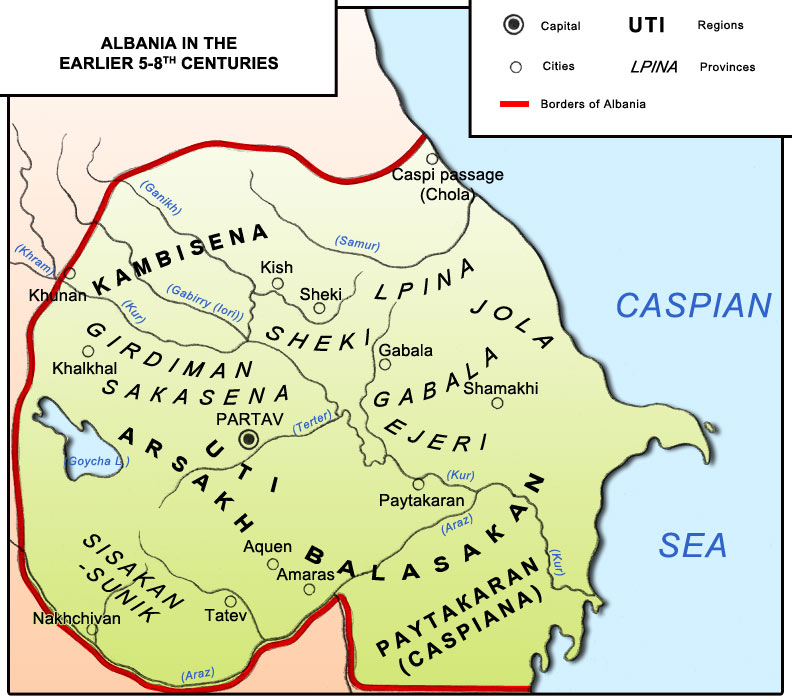
Abas,* bishop of Partaw,** the See of the Albanian*** Chalcedonian**** Church (Pahlavi: Partaw; now Barda, Azerbaijan);
Moses, bishop of Balalat;
Grigor, bishop of Kapalak (now Qabala, Azerbaijan);
Hromak, bishop of Amaras (now Amaras town in Khojavend, Azerbaijan);
bishop of Arc'ax (from Parthian: Aršak/ Arsak?, possibly originating from the name of the ruling Parthian Arsacid/ Aršakid dynasty of Albania; now Karabakh, Azerbaijan);
bishop of Uti/k (old: Šamkūr, now Shamkir and around Ganja city, Azerbaijan);
bishop, Kambisena (Pahlavi: Kambičan, now in Georgia);
bishop of Čor/ Čōl (now Torpakh-Kala (Pahlavi: Šebergah or "royal city-fortress" Šahr-i Yazdagird, near Derbent, Russia);
Simeon, bishop of Mets Irank;
bishop of Vostan Imartspan (Pahlavi: v-ostan i marz-ban? "place of marzban [governor]", now possibly Derbent, Russia);
bishop of the "great city-fortress" Tsri/ Tri of Albania (around Zagatala or Qakh cities, Azerbaijan);
bishop of Yekhnibekh;
bishop of Siunia/ Siwnik (Pahlavi: Sisagān, now Syunik, Armenia);
Timothy, bishop of Paytakaran/ Balasakan/(Parthian: karan [land]/ Payt' karan [land of Payt (tribe or name)], Pahlavi: Balāsagān; now part of Iran; and Lankaran, Salyan and city of Baylagan, Azerbaijan);
Habakkuk, bishop of Šak‘ē (Pahlavi: Šakki; now Sheki, Azerbaijan);
Yohanik, later Nerses, bishops of Gardman (Phalavi: Šakašēn; now near the Girdiman river and the old fortress of Getabakk, nowadays Qazakh/ Kedabek/ Gedabay, Azerbaijan);
Lewond and later Israel, bishop of Meckolmank/ Mets Kol-mank. Bishop Israel held negotiations with the Huns in 682.
Monastery of Nersmehr/ Nersmihr******* (built on old pagan and sacred place, related to deity Mithra/, Avestan: Miθra, Pahlavi: Mehr/ Mihr), Aghdara, Karabakh, Azerbaijan;
Caucasian Albanian Church's Chalcedonian Monasteries in Jerusalem, around 638 CE
- Monastery of Pant, dedicated to St. John
the Baptist, (possibly named after Bishop Pant, an early head of the Albanian
Church in the beginning of 6th century), established around the 4th century;
- Monastery of St. Theotokos (St. Mary) of Arc’ax;
- Monastery of Mrouv;
- Monastery of St. Gregory of Amaras, dedicated to Gregory the Illuminator;
- Monastery of St. Theotokos (St. Mary) of Partaw;
- Monastery named after the Holy Cathedral [S. Kat'olike Ekelec'i] in the city of Vagharshapat (Old Persian: Valashāpāt/ Balashāpāt, named after Valash/ Balash, a Parthian ruler of Armin, Latin: Armenia)******;
- 4 other monasteries occupied by the Muslims.
Notices:
*At the time, Bishop [ter]-Abas (God-protected lord [ter], in office 552-596) was Catholicos of the Albanian Apostolic Church. He successfully gained autocephaly (from Greek, self-headed) for the Church of Albania.
** The original name was a "great city" of Pērōz-Kavāt/ Pērōzāpāt, i.e., “Prosperous Peroz” or "the city of Pērōz". It was renamed to Partaw (Old Persian: Parθaυa, Parthian: Parθaυ, "Parthia", Middle Persian: Pahlav, now Barda from Arabic: برذعة, Bardhaʿa, [means Parthia], Azerbaijan), possibly between 484-488 under the reign of Arrānshāh Vačagan III the Pious, holding the status of the capital city of Arrān (Latin: Albania).
***Also called Church of Arran (Pahlavi: Arrān).
**** Followed the decision of the Council of Chalcedon (451 AD) on the dyophysite nature of Christ.
***** The total number of the Albanian Church's monasteries in the Holy Land was 10.
****** This possibly indicates that the Cathedral of the Armenian Church in Ejmiadzin (Vagharshapat) was originally the Albanian Chalcedonian Church, where the Chalcedonian Dyophysite/ Orthodox Byzantine Emperor Heraclius was stationed in 624 AD. It is difficult to imagine that dyophysite Heraclius was in the miaphysite/ monophysite anti-Chalcedonian church. It is well known that the Russian Tsar (1836) transferred all the survived Caucasian Albanian churches under the jurisdiction of the miaphysite Armenian Church.
******* Albanian king (Arrānshāh) Vačagan III (Pious) erected a chapel on the place where the relics of St. Elišay of Albania (first patriarch of the Church of Albania) were buried. The king himself was also buried in this site after his death.
Sources:
Baumer Christoph, "History of the Caucasus, At the Crossroads of Empires", Volume 1. London: I.B. Tauris, 2021. 392. ISBN: 978-1-78831-007-9.
Whirby Michael, “The Ecclesiastical History of Evagrius Scholasticus”, Liverpool University Press, 2000, 454.
Kałankatuac̣i Moses, (Movsēs Daskhurantsʻi), “The History of the Caucasian Albanians”, Trans: Dowsett Ch., London, 1961, 252.
Terian Abraham, Monastic Turmoil in Sixth-Century Jerusalem and the South Caucasus: The Letter of Patriarch John IV to Catholicos Abas of the Caucasian Albanians, Dumbarton Oaks Papers 74, 2020, 9-39.
Archimandrite Alexy (Nikonorov), Dioceses of the Albanian church by the sixth century, available at: https://ethnoglobus.az/343-dioceses-of-the-albanian-church-by-the-sixth-century.html
Chaumont
Michael, “ALBANIA”, Encyclopedia Iranica, I/8, pp. 806-810; an updated version is
available online at http://www.iranicaonline.org/articles/albania-iranian-aran-arm
(accessed on 17 May 2014).
Garsonian Nina, The Marzpanate (428-652), Chapter 5, In: “The Armenian People from Ancient to Modern Times. I. The Dynastic Periods: From Antiquity to the Fourteenth Century”, Ed: Richard G. Hovannisian R., New York, St Martin Press, 1997, 95-115.